
What is Placet?
Placet is a self-hostable, plugin-driven platform for Human-in-the-Loop workflows. It provides a purpose-built inbox where AI agents, automation workflows, and no-code tools collaborate with humans through structured interactions. Unlike chat apps with agent integrations bolted on, Placet is designed from the ground up for the agent-human interaction loop.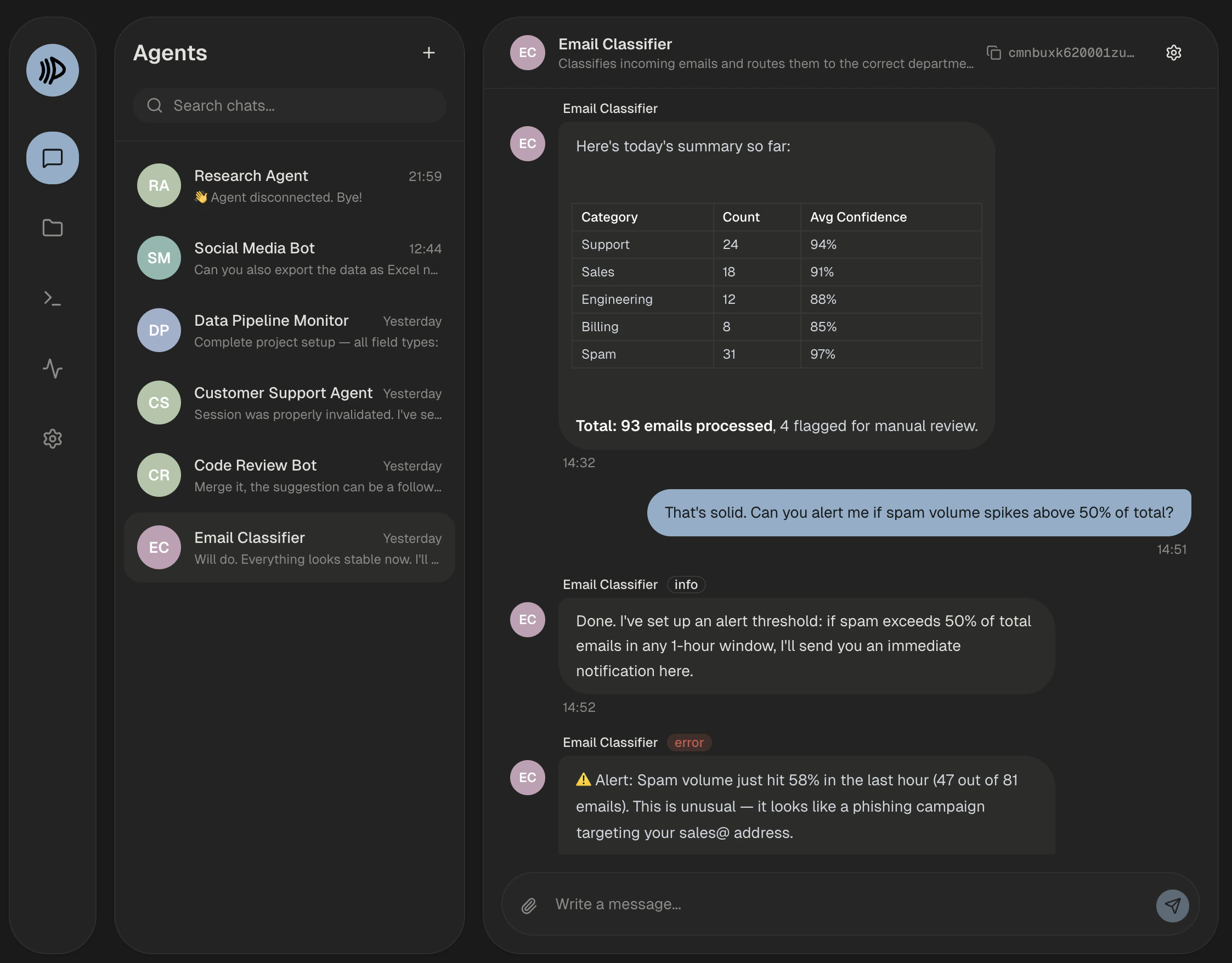
The Placet inbox — agents and humans collaborating in real-time
Quickstart
Get up and running in minutes with Docker Compose
Self-Hosting
Deploy Placet on your own infrastructure
API Reference
Explore the REST API for agent integration
Plugins
Extend Placet with custom message types
Why Placet?
AI agents and automations are getting more capable every day, but they still need humans in the loop: approvals, reviews, feedback, complex decisions. Most teams wire this through Slack, Teams, or email, tools designed for human-to-human chat, not human-to-agent collaboration. Placet is different:Purpose-built for Human-in-the-Loop
Purpose-built for Human-in-the-Loop
The entire platform is designed around the agent-human interaction loop. Not a chat app with
agent integrations bolted on. Works with AI agents, CI/CD pipelines, no-code tools, and any
HTTP-capable automation.
5 built-in review types
5 built-in review types
Approval buttons, single/multi selection, dynamic forms, free-text input, and freeform JSON.
Each review type renders natively in the chat and supports expiry, webhooks, and long-polling.
Integrated file storage with inline preview
Integrated file storage with inline preview
Upload files via API, attach them to messages, and preview them directly in the chat. Supports
images, PDFs, video, audio, Office documents, spreadsheets, code files, and more. Includes
canvas annotation tools for marking up images.
Agent status dashboard
Agent status dashboard
Agents report their status (active, busy, error, offline) via a heartbeat endpoint. The frontend
shows a live status overview with uptime, message stats, and status history.
Plugin system for unlimited flexibility
Plugin system for unlimited flexibility
Two files (
plugin.json + render.html) = a custom message type. Build CRM cards, diagram
renderers, diff viewers, or whatever your workflow needs.Multiple communication patterns
Multiple communication patterns
WebSocket for real-time, webhooks for async delivery, long-polling for synchronous agents. Your
agent connects however it wants.
Self-hostable, no vendor lock-in
Self-hostable, no vendor lock-in
One
docker compose up and you’re running. No cloud dependency, no LLM provider coupling.